



Notary and Translation Services in Byron Bay
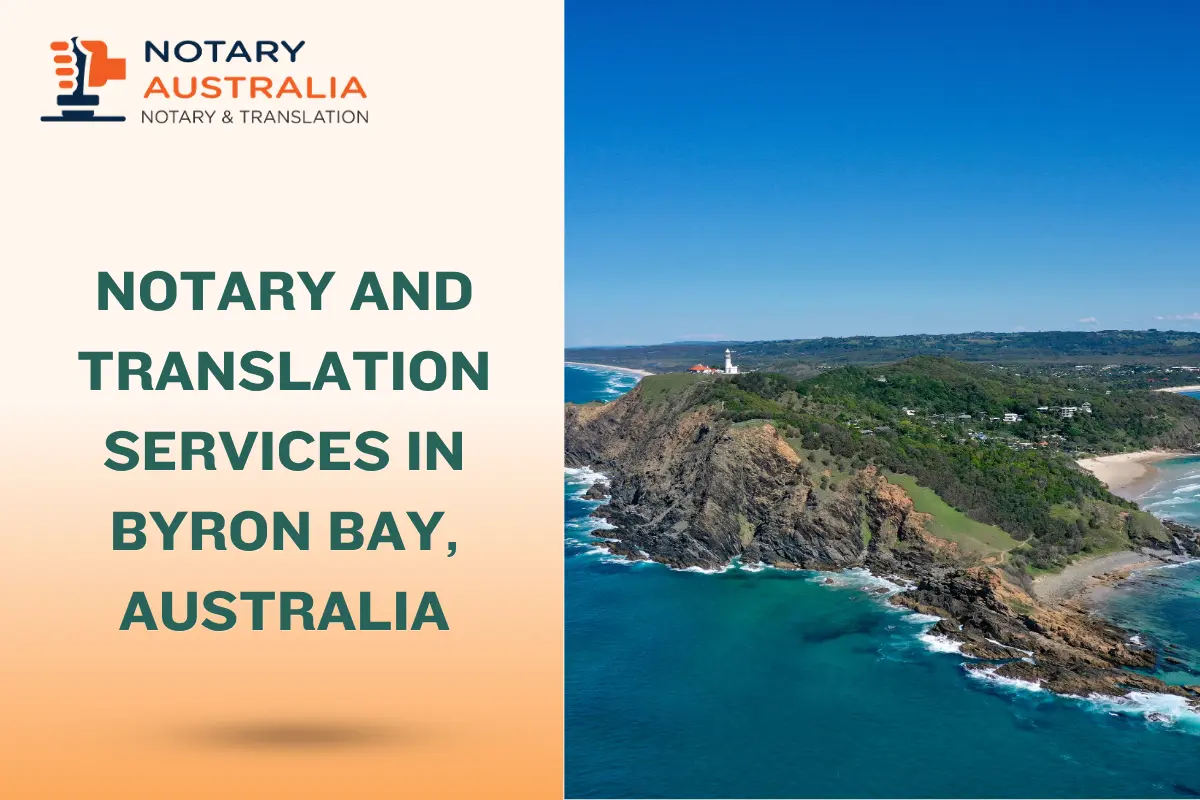
Table of contents
Byron Shire has an unusually international population for a regional council area. Almost a third of residents were born overseas, many in Europe and the Americas. That shapes what people here need from a notary: documents for property, pensions, banks and family in other countries. Some residents also expect a US-style notary, which Australia does not have. This guide covers how to get documents notarised, legalised and translated from the far north coast of NSW.
Byron Bay and Byron Shire
Byron Bay is one of several towns in Byron Shire, whose council is based in Mullumbimby. Others include Bangalow, Brunswick Heads and Suffolk Park. The council acknowledges the Arakwal, Minjungbal and Widjabul Wia-Bal people of the Bundjalung Nation as Traditional Owners.
The 2021 Census counted 36,116 people in the shire. Only 67.7% were born in Australia. The largest overseas birthplaces were England (5.3%), New Zealand (2.4%), the United States (1.3%), Germany (1.3%) and Brazil (0.8%). After English, the most common languages at home were Spanish (1.6%), German (1.1%), French (1.0%), Portuguese (0.9%) and Italian (0.8%).
The Census also shows how much the shire lives on visitors. Cafes and restaurants employed 5.4% of working residents, against 2.0% across NSW. Accommodation employed 4.1%, against 0.8%.
Popular places and things to do
- Walgun Cape Byron. The headland is the most easterly point of mainland Australia. Walgun is the name used by its traditional custodians, the Bundjalung of Byron Bay (Arakwal) people. NSW National Parks manages it as a state conservation area.
- Cape Byron Lighthouse, built in 1901. Its 22 m white tower still lights the bay at night, and keepers lived on site until 1989. A maritime museum occupies the former keeper's office.
- Whale watching from the headland walking track. NSW National Parks gives the season as May to October. Dolphins can be seen year-round, and turtles are also sighted.
What Byron residents often need
Documents for Europe, the UK, the Americas and New Zealand. A power of attorney for a property sale abroad, a certified passport copy for a foreign bank, or a statutory declaration for a pension fund. The route depends on the destination. If it is a party to the Hague Apostille Convention, you need a notary (for a private document) and then a DFAT apostille. If it is not, you need DFAT authentication and then legalisation at that country's embassy or consulate. Check the HCCH status table on the day you apply, because membership changes.
Documents issued overseas for use here. A German, Brazilian or American document needed in Australia is generally certified and legalised in the country that issued it. An Australian notary cannot vouch for a foreign registry's record.
American forms. An Australian notary is not the same as a US notary public. In Australia, notaries are experienced lawyers, appointed in NSW by the Supreme Court. An Australian notary can witness your signature on many US forms. Some US institutions, though, want particular wording, or point you to a US consulate instead. Ask the receiving institution which it accepts before you book.
Getting it done
Is a JP enough? For documents used in Australia, often yes. A Justice of the Peace can witness a statutory declaration and certify copies, including copies for Department of Home Affairs visa applications. JPs are free volunteers. The NSW JP Public Register can be searched by postcode, language and availability. A JP's certification is not accepted overseas and cannot be apostilled.
Finding a notary. The Society of Notaries of New South Wales has a Find a Notary search by name, postcode, region and foreign language. It includes a Northern Rivers region. The language filter matters here if you would rather deal with someone who speaks German, Spanish, French or Portuguese. Bring the original document and photo ID. A notary will not work from a scan or photocopy, and will check that you understand what you are signing.
DFAT. Only DFAT issues apostilles and authentications in Australia. It accepts documents at any Australian Passport Office, by appointment only, and someone can attend on your behalf. For most of the shire, Brisbane is the nearest office. Otherwise, send documents by registered post to DFAT's Authentications Section at its Melbourne or Sydney GPO box (addresses on Smartraveller), with a self-addressed registered post envelope for their return. Some original public documents can go to DFAT without a notary. These include NSW birth and marriage certificates, national police checks and court documents, but confirm with DFAT first.
Translations
A document going to an Australian agency needs a NAATI-certified translator, found through the NAATI Online Directory by language. For a document going overseas, the receiving authority decides whose translation it accepts. Some European authorities prefer translators they have sworn in themselves, so ask first. If DFAT is to legalise a translation, each page needs the NAATI translator's name, signature, seal, practitioner ID and the date.
Frequently asked questions
Where can I get a form notarised in Byron Bay? We do not list individual notaries. Search the NSW Society's Northern Rivers region, and bring the unsigned form, the original of any document to be copied, and photo ID.
Will an Australian notary's stamp be accepted in the US? Often, with a DFAT apostille added, but the US institution decides. Ask it first.
Can a JP certify my passport copy for a European bank? Usually not. JP certifications are not accepted overseas. Use a notary.
More for New South Wales
JPs witness statutory declarations and certify copies for use in Australia; NSW JPs are not authorised to witness documents for use overseas, which need a notary.
- JP or Notary in NSW: Choosing the Correct Witness
- Notary Public in Sydney: How to Get Documents Notarised
- Notary and Translation Services in New South Wales
- Notary Services in Sydney: Booking an Appointment
- Albury–Wodonga
- Ballina
- Batemans Bay
- Bega, NSW
- Bourke
- Broken Hill
- Campbelltown
- Coffs Harbour
- Coonabarabran
- Corowa
- Dubbo
- Glen Innes
- Moree
- Port Macquarie
- Tamworth
- Tumut
- Wagga Wagga