



How to Notarise a Death Certificate in Australia
Table of contents
When someone dies with a bank account, a pension, property or an insurance policy in another country, the family in Australia is usually asked for a notarised or authenticated Australian death certificate. The request tends to arrive at a hard time, often alongside a dozen others, and it is easy to send the wrong document, or the right document on its own.
This page covers what an Australian death certificate is, whether you need a notary for it at all, and what else an overseas institution will almost certainly want with it.
What an Australian death certificate is
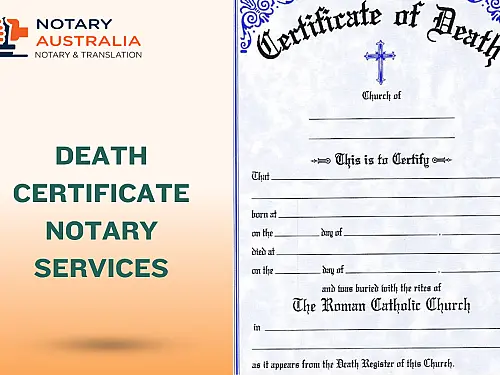
An Australian death certificate is issued by the Registry of Births, Deaths and Marriages in the state or territory where the death was registered, once registration is complete. The funeral director usually lodges the registration, and the certificate follows from the registry.
In the days after a death, families gather other paperwork: a doctor's medical certificate of cause of death, documents from the funeral director, sometimes a hospital letter. None of these is a death certificate. You cannot get a death certificate from a funeral home itself, and you cannot make one; only the registry issues it. A notary cannot certify the funeral director's paperwork as a death certificate, and a foreign institution will not accept it as one. If you do not yet have the registry certificate, obtain that first.
Registries limit who may order a death certificate, usually to close family, executors and others who can show a legitimate interest. The rules differ between states and territories. If you are overseas, or not next of kin, check the registry's eligibility rules before assuming you can order one.
Can you notarise a death certificate?
A notary can certify a copy of a death certificate. The notary sights the original registry certificate and certifies that the attached copy is a true and complete copy of it. The notary does not attest to the death or to anything else recorded on the certificate; only the registry can do that.
A "notarised death certificate", then, means a notarially certified copy. It is useful when an overseas institution wants a certified copy rather than the original, or when you need several certified sets for several institutions and want to keep the original.
You may not need a notary: authentication of the original
This is worth checking before paying anyone. Death certificates are on the list of Australian public documents that the Department of Foreign Affairs and Trade (DFAT) says it can legalise. That means DFAT may be able to apostille or authenticate the original registry certificate directly, with no notary involved. DFAT will not accept a certificate that has been laminated, framed or altered.
Whether the original or a notarised copy is the better route depends on the receiving institution. Some want the original with an apostille. Others are happy with a notarised copy, which lets you keep the original for everyone else. Ask the institution, and confirm DFAT's current requirements before lodging.
Apostille or legalisation
For a country that is a member of the Hague Apostille Convention, DFAT issues an apostille, either on the original certificate or on the notarised copy. For other countries, DFAT authenticates it and the destination's embassy or consulate in Australia legalises it. Membership changes, so check the HCCH status table on the day. No notary can issue an apostille; only DFAT can.
When a coroner is involved
Where a death is reported to a coroner, registration, or the recording of the cause of death, may be delayed while the coroner's investigation proceeds. Ask the registry what can be issued in the meantime. Some foreign institutions will not accept a certificate that shows no cause of death; others do not mind. Ask before paying to authenticate a certificate that may later be superseded.
Proof of death is only half of it
The foreign institution needs to know two things: that the person has died, and that you are entitled to deal with what they left. The death certificate answers only the first.
Depending on your role, expect to also need certified copies of:
- the grant of probate or letters of administration, if you are the executor or administrator
- the will, which may be attached to the grant
- your own birth or marriage certificate, if you are claiming as a child or spouse and need to show the relationship
- your passport, as evidence of your own identity
Institutions also routinely send their own forms: claim forms, declarations of heirship, indemnities. Many need your signature witnessed by a notary. Bring them to the same appointment. One visit with the full bundle is simpler than three visits with one document each.
What is probate?
Probate is the court's formal recognition that a will is valid and that the executor named in it has authority to deal with the deceased person's estate. In Australia, the grant of probate is made by the Supreme Court of the state or territory concerned. Where there is no valid will, the court may instead grant letters of administration to an administrator.
Overseas institutions often ask for the grant because it is the document that proves who may act. How probate works in Australia, how long it takes and what it costs depend on the state or territory and the estate. Those are questions for a probate lawyer, not a notary. A notary's part is narrower: certifying copies of the grant and will for overseas use, and witnessing the executor's signature on foreign forms.
Watch for name differences
Death certificates record names as registered, which can differ from the name on a foreign bank account or pension file: a married name against a birth name, a transliterated spelling, a dropped middle name. The institution may reject the set even though every document is genuine. A declaration by the executor or next of kin explaining the difference, made before the notary at the same appointment, is usually the fix.
At the appointment
Bring photo identification and the originals. The notary sights each original, prepares the certified copies, witnesses any forms you need to sign and records each act in their register. If you are signing declarations, the notary will want to be satisfied that you understand them and are signing freely. Where an interpreter is needed, it should be someone independent rather than a family member with an interest in the estate.
Common questions
Can a Justice of the Peace certify the death certificate instead? For use in Australia, yes. For use overseas, no: a JP's certification is not recognised abroad and cannot be apostilled.
The overseas bank wants the original. Should I send it? Ask whether a notarised and apostilled copy will do. If the bank insists on an original, consider ordering a second certificate from the registry for it, so you keep one for everyone else.
The death happened overseas. Can an Australian notary help? The certificate comes from the country where the death occurred, and its authentication follows that country's system. An Australian notary cannot vouch for a foreign registry's document.
What does it cost? The registry, the notary and DFAT each charge separately, and the bundle around the certificate usually costs more than the certificate itself. Ask for written quotes.
How recent must the certificate be? The certificate does not go out of date, but some institutions want recently certified copies. Ask.