



Notary and Translation Services in Mount Gambier
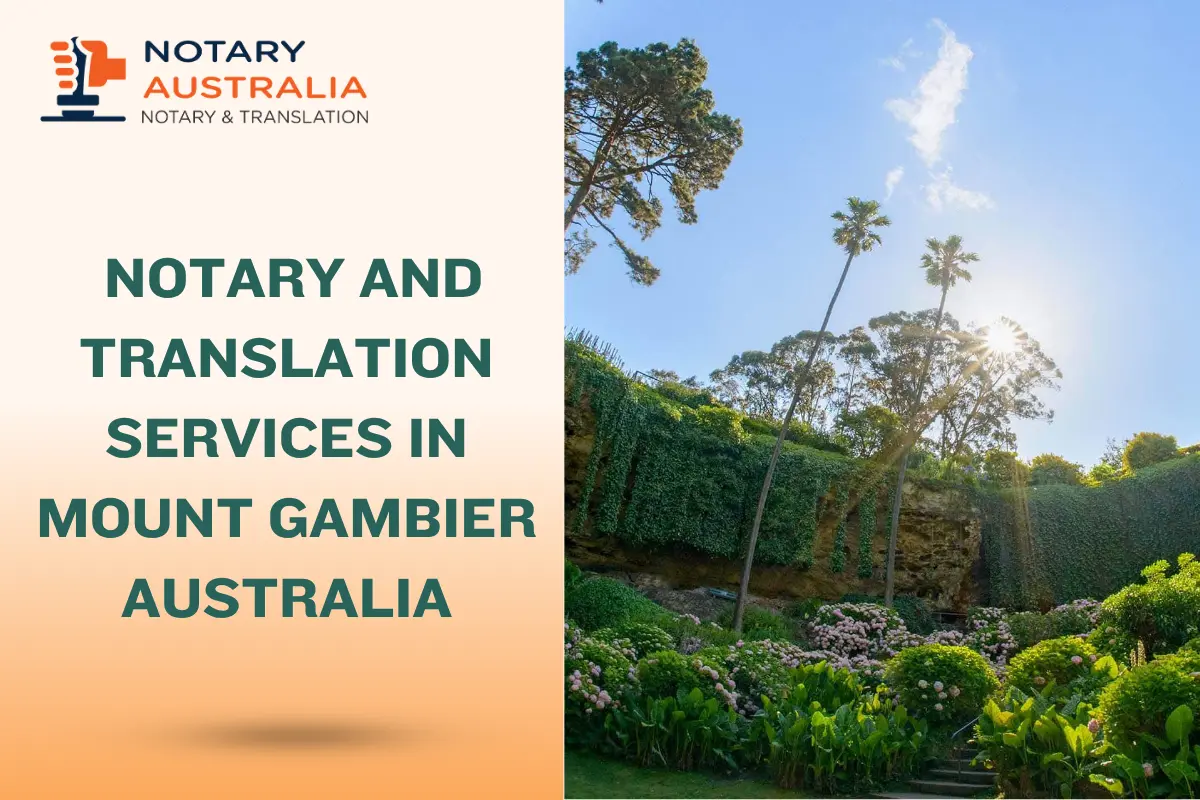
Table of contents
Unlike many of the regional towns we cover, Mount Gambier had notaries with local addresses on the state notary society's listing when we checked. The DFAT step still happens in a capital city or by post. Mount Gambier also has an unusual language profile: the most common language after English is Karen, from Myanmar. This guide covers notaries, JPs, DFAT and translations for the city and the wider Limestone Coast.
Mount Gambier and its council
The City of Mount Gambier acknowledges the Boandik peoples as the traditional custodians of the land the city sits on, which they call Berrin. The council describes the city as halfway between Adelaide and Melbourne. It calls it the regional centre of South East South Australia and western Victoria.
At the 2021 Census the council area had 26,878 residents, with a median age of 41. Most (82.9%) were born in Australia. The largest overseas birthplaces were England (2.5%), New Zealand (0.8%), Myanmar (0.8%) and Thailand (0.6%). The most common language at home other than English was Karen (1.4%), ahead of Italian (0.6%), Swahili, Mandarin and Punjabi. Karen and Karenni refugees from Myanmar, many of whom had spent years in camps on the Thai border, began settling in Mount Gambier around 2007, according to the ABC.
Popular places and things to do
- The Blue Lake/Warwar. It is the largest crater in the city's volcanic complex. It turns from grey in winter to bright blue from about November to March. A 3.6 km road and walking track circles it, with lookouts. Warwar means "the sound of many crows" in Bunganditj, the Boandik language. The lake also supplies the city's drinking water.
- Cave Garden/Thugi, a sinkhole in the city centre about 25 m wide and 18 m deep, formed when an underground cave collapsed. Thugi, meaning "bullfrogs", was added to its name in 2022.
- Umpherston Sinkhole/Balumbul, a sunken garden in another collapsed limestone cave, with terraces and hanging vines. The council has been consulting on a master plan for its future.
- The volcano itself. The state environment department says volcanic activity about 4,000 years ago made Mount Gambier Australia's most recent volcanic site. The area is a State Heritage Area.
Finding a notary in South Australia
In South Australia, notaries public are admitted by the Supreme Court of South Australia. Applicants must have been legal practitioners for at least five years. The Notaries' Society of South Australia has a find-a-notary listing arranged by region. When we checked it, its Country South Australia section included notaries with Mount Gambier addresses. We do not name them here. Check the current listing, and ask when you book whether the notary handles your type of document.
Bring the original document and photo ID. A notary will not certify from a scan or photocopy, and will check that you understand what you are signing.
When a JP is enough
For documents used in Australia, such as statutory declarations and certified copies for Home Affairs, a bank or a university, a Justice of the Peace is free and usually enough. South Australia's Attorney-General's Department has a JP search by suburb and language, and the state government notes that most libraries offer JP services. A JP's certification is not accepted overseas and cannot be apostilled.
If you live over the border in western Victoria, Victorian statutory declarations follow Victoria's own rules on who may witness them.
Getting documents to DFAT
Only DFAT issues apostilles and authentication certificates. It takes documents at any Australian Passport Office, by appointment only, and someone can attend on your behalf. From Mount Gambier, Adelaide and Melbourne are roughly equal choices. Or send the documents by registered post to DFAT's Authentications Section at its Melbourne or Sydney GPO box (addresses on Smartraveller), with a self-addressed registered post envelope. Some original public documents need no notary. These include South Australian birth and marriage certificates, national police checks and court documents, but confirm with DFAT first.
Documents for Myanmar and Karen translations
For a document going to Myanmar, check on the HCCH status table whether Myanmar is a party to the Apostille Convention on the day you apply. If it is not, DFAT authenticates the document and it then goes to Myanmar's embassy for legalisation. Documents issued in Myanmar for use here are generally certified there, not by an Australian notary.
For translations into English for an Australian agency, use a NAATI-credentialled translator. Search the NAATI Online Directory for Karen, Burmese or Swahili. For languages with few certified translators, NAATI also issues a "recognised" credential, and DFAT accepts translations from NAATI certified or recognised translators. Each page must show the translator's name, signature, seal, practitioner ID and the date.
Frequently asked questions
Is there a notary public in Mount Gambier? When we checked, the Notaries' Society of SA listed notaries with Mount Gambier addresses. Check the current listing.
Can a JP certify documents for overseas? No. Use a notary, or send original public documents to DFAT directly.
Do I have to go to Adelaide? No. You can post documents to DFAT.
More for South Australia
South Australian JPs witness local documents; documents for overseas use need a notary.
- Who Can Witness Documents in South Australia
- Notary Public in Adelaide: How to Get Documents Notarised
- Notary Services in Adelaide: Booking an Appointment