



Documents You Must Have Notarised for an Australian Tourist Visa
Table of contents
For most visitors, the answer is none.
A visitor application is normally lodged online from outside Australia, with uploaded scans. The Department of Home Affairs does not generally ask for notarised documents from a tourist, and where it asks for a certified copy, the range of people who may certify is broad. Confirm the current requirements against Home Affairs guidance for the stream you are applying under.
The reason people search for this is usually not Home Affairs at all. It is an agent, a relative, an airline or the applicant's own government asking for something — and those are four different problems.
Documents your own country asks for
Some countries impose exit formalities on their own nationals: permission to travel, currency-control clearance, employer or military release. These are documents issued in the applicant's country, notarised there, and given to an authority there. They have nothing to do with Australia and cannot be handled by an Australian notary.
If someone has told you a document must be notarised for the visa and you are still overseas, this is the most likely thing they mean.
Invitation and sponsorship from an Australian relative
An Australian resident inviting a family member usually writes a letter describing the relationship, the purpose and duration of the visit, and any support being offered. A letter of this kind does not normally need to be notarised for Home Affairs.
It sometimes does need to be notarised for someone else — an employer requiring proof before granting leave, a bank, or a home-country authority assessing the applicant's reason to return. Where that is the case it is an Australian document going overseas: notarised here, then apostilled by DFAT if the destination is a party to the Hague Apostille Convention, or DFAT-authenticated and then legalised at that country's embassy or consulate if it is not.
Ask who wants it and why before paying. "My agent said to notarise it" is not an answer to that question.
A child travelling without both parents
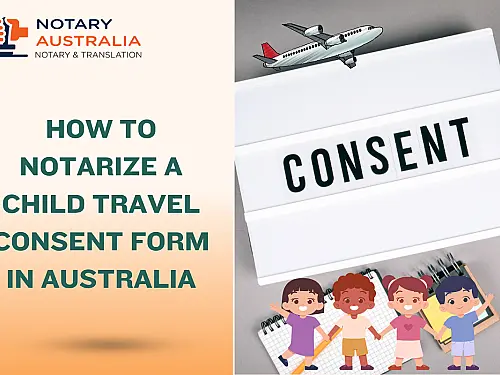
This is the one genuinely common notarial job in the visitor stream, and the request usually comes from an airline or a departure-country border authority rather than from Home Affairs.
Where a minor travels alone, with one parent, or with a grandparent or other relative, a consent letter from the non-travelling parent or parents is frequently expected. Notarisation is what makes it credible to someone who has never met the family, and some countries also want an apostille or legalisation on top.
Requirements vary by airline and by the country being departed, so confirm with both — the carrier and the departure authority — rather than assuming. Where the non-travelling parent is in Australia, that consent is an Australian document notarised here and then authenticated for the destination.
Financial and property evidence
Bank statements, property titles, business ownership and employment letters are often provided to show ties to home. Where these are foreign documents, any authentication happens in the issuing country. Where they are Australian documents supporting an overseas relative's application, they are ordinary copies in most cases.
A notary cannot attest that the contents of a bank statement are true. A notary attests identity, signature and the making of a declaration. That distinction is worth understanding before buying a service that will not do what you want.
Translation
Documents not in English need an English translation. For Australian immigration purposes, translations done in Australia should be by a NAATI-credentialled translator. Translations done overseas should carry the translator's full name, address and credentials.
A notary does not translate, but can attest a translator's declaration and bind the translation to its original — which foreign authorities often want and Home Affairs usually does not require.
Sequence, for a consent letter or invitation going overseas
- Ask the airline, the departure authority or the recipient exactly what they require, including whether an apostille is needed
- Sign before an Australian notary
- DFAT apostille, or DFAT authentication plus embassy legalisation
- Translate if the destination requires it
Timing
Visitor travel is usually booked before the paperwork is started, which is the wrong order.
- Notarial appointment: same day to a few days
- DFAT apostille: allow a week or more
- Embassy legalisation: days to over a month, by country
- Certified translation: a few days, longer for uncommon languages
If a consent letter needs an apostille, that is not a task for the week of departure.
Frequently asked questions
My travel agent says my documents must be notarised. Is that right? Ask who is going to receive the notarised document. If the answer is the Department of Home Affairs, it is very likely unnecessary. If the answer is an authority in the applicant's own country, it probably is necessary — and it must be done there.
Can I notarise my relative's overseas bank statements here in Australia? No useful version of that exists. A foreign bank document is authenticated in its own country, and no notary anywhere can certify that the balance is real.
My parents are visiting and need an invitation letter. Does it need a notary? Usually not for the visa itself. If their employer, bank or local authority wants a notarised version, that is a different recipient with a different standard, and it is answerable only by asking them.
My grandchild is flying out with only their mother. What do we need? Ask the airline and the departure country's border authority. A notarised consent letter from the other parent is a common answer, sometimes with an apostille. Requirements are set by them, not by Home Affairs.
Does an electronic travel authority need any documents at all? The streams differ in what they ask for. Check the current Home Affairs guidance for the specific stream rather than assuming the heaviest requirements apply.