



Notary and Translation Services in Bairnsdale
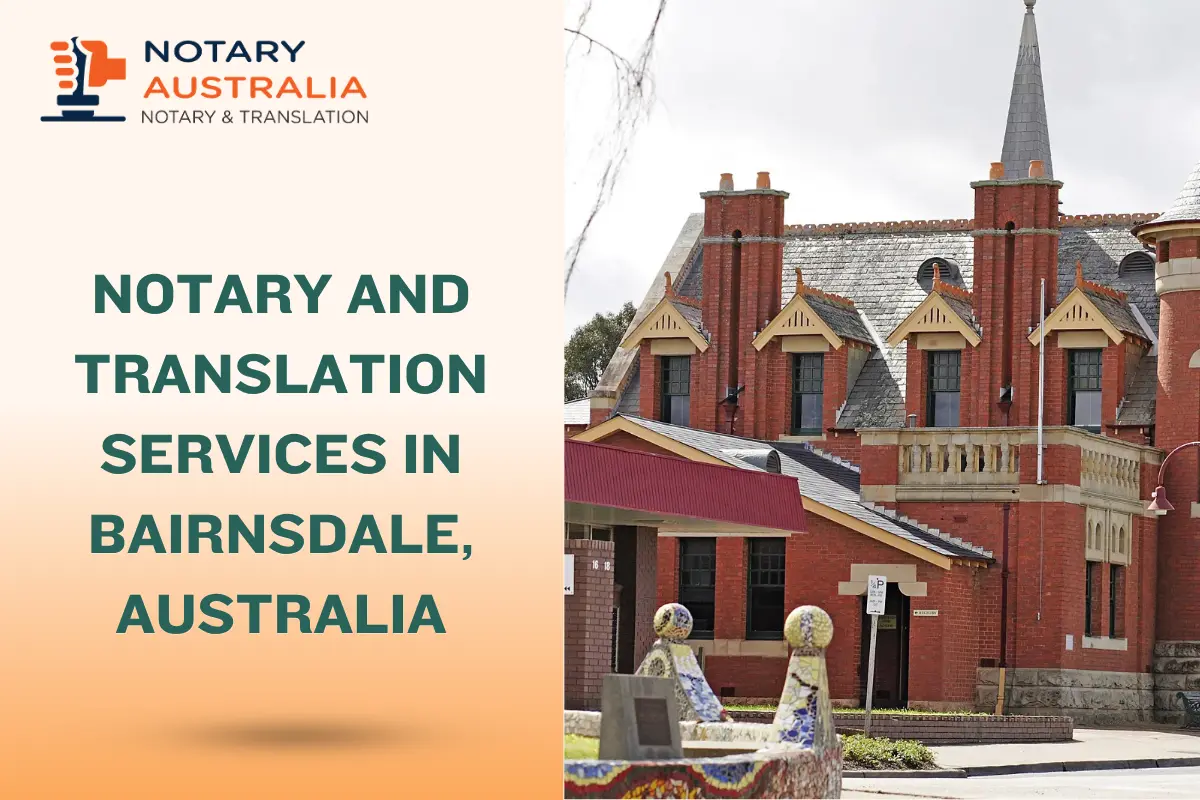
Table of contents
People in Bairnsdale and the rest of East Gippsland often search for a "local" translator or notary. For translations, being local matters much less than people expect. For the DFAT step, the nearest counter is in Melbourne, which the regional tourism body puts 285 km away. This guide explains what you can do from Bairnsdale and what has to go to Melbourne or into the post.
Bairnsdale and East Gippsland Shire
Bairnsdale is the largest town in the East Gippsland Shire and, in the council's words, "the primary service and administrative hub for the shire". The council says the Bairnsdale District is home to more than 17,000 people and is forecast to reach 23,000 by 2046. It is the regional centre for shopping, health services, education, and arts and culture.
The town sits on the Mitchell River, 285 km east of Melbourne, on the land of the Gunaikurnai people. It was a port for steamboats and traders in the 1850s. The area was settled in the 1840s and became a shire in 1868.
The 2021 Census counted 13,734 people in the Bairnsdale urban area, and 80.6% were born in Australia. England, the Philippines, New Zealand, India and the Netherlands were the largest overseas birthplaces. Hospitals were the largest employer. More unusually, factory-based cake and pastry manufacturing employed 3.1% of working residents, against 0.1% across Victoria.
Popular places and things to do
- St Mary's Church, whose interior murals by the Italian artist Francesco Floreani are the town's best-known sight.
- Krowathunkoolong Keeping Place, a museum of Gunaikurnai history, culture and traditional artworks.
- Howitt Park, at the eastern end of town, with a canoe tree of deep Aboriginal significance. It is a stop on the Bataluk Cultural Trail.
- East Gippsland Art Gallery, the rotunda at the centre of town, and the 19th-century Bairnsdale Courthouse.
- The Gippsland Lakes, for which Bairnsdale is the gateway, with the High Country and national parks within reach.
Translations: you do not need someone in Gippsland
If a document is going to an Australian agency, such as Home Affairs, a Victorian registry or a court, the translation should be done by a NAATI-certified translator. NAATI certification is the same in every state. A certified translator in Melbourne, Brisbane or anywhere else in Australia is just as acceptable as one in Bairnsdale, and many work from emailed copies. The NAATI Online Directory lets you search by language and filter by location if you want someone nearby.
If the translation is for use overseas, the receiving authority decides whose translation it accepts. Ask it before you order. For DFAT to legalise a translation, it must be by a NAATI-certified or recognised translator, with their name, signature, NAATI seal and practitioner ID, and the date on every page.
Notarising and legalising a document from Bairnsdale
- Ask the receiving authority whether it wants a notarised document, an apostille, or embassy legalisation. The answer depends on whether the destination is a party to the Hague Apostille Convention. Check the HCCH status table on the day.
- See whether you can skip the notary. DFAT can legalise original Australian public documents, such as a Victorian birth, death or marriage certificate, a national police check or a court document, without a notary. Confirm with DFAT first. Laminated or altered certificates are refused.
- Find a notary if you need one. The Supreme Court of Victoria appoints public notaries, and the Society of Notaries of Victoria publishes a find-a-notary listing. Take the original document and photo ID. A notary cannot work from a scan.
- Lodge with DFAT. The in-person option is the Australian Passport Office in Melbourne, by appointment only, and someone can attend on your behalf. From East Gippsland, registered post is often simpler: send the documents to DFAT's Authentications Section at its Melbourne or Sydney GPO box (addresses on Smartraveller), with a self-addressed registered post envelope. DFAT does not publish a fixed turnaround.
When a JP is enough
For Australian purposes, a Justice of the Peace is free and often enough, including for certified copies going to the Department of Home Affairs. Victoria's Department of Justice lists JPs you can book and document signing stations you can walk into. It also points to a booking tool for remote witnessing by a JP.
A JP's certification is not accepted overseas and cannot be apostilled. If a document is leaving Australia, use a notary, or send original public documents to DFAT.
Frequently asked questions
Do I need a NAATI translator who lives in Gippsland? No. NAATI certification is national. Search the NAATI Online Directory by language.
Is there a notary in Bairnsdale? We do not list individual notaries. Check the Society of Notaries of Victoria's listing and ask whether remote options suit your receiving authority.
Where is the nearest place to get an apostille? DFAT at the Melbourne passport office, by appointment, or by registered post.
Can a JP in Bairnsdale certify documents for overseas? No. JPs certify for Australian use only.
More for Victoria
JPs and bail justices are free witnesses for Victorian and Commonwealth documents; documents for overseas use need a notary.
- Witnessing Documents in Victoria: Authorised Witnesses
- Notary Public in Melbourne: How to Get Documents Notarised
- Notary and Translation Services in Victoria
- Craigieburn
- Frankston
- St Albans
- Wangaratta
- Warrnambool