



Notary and Translation Services in Frankston
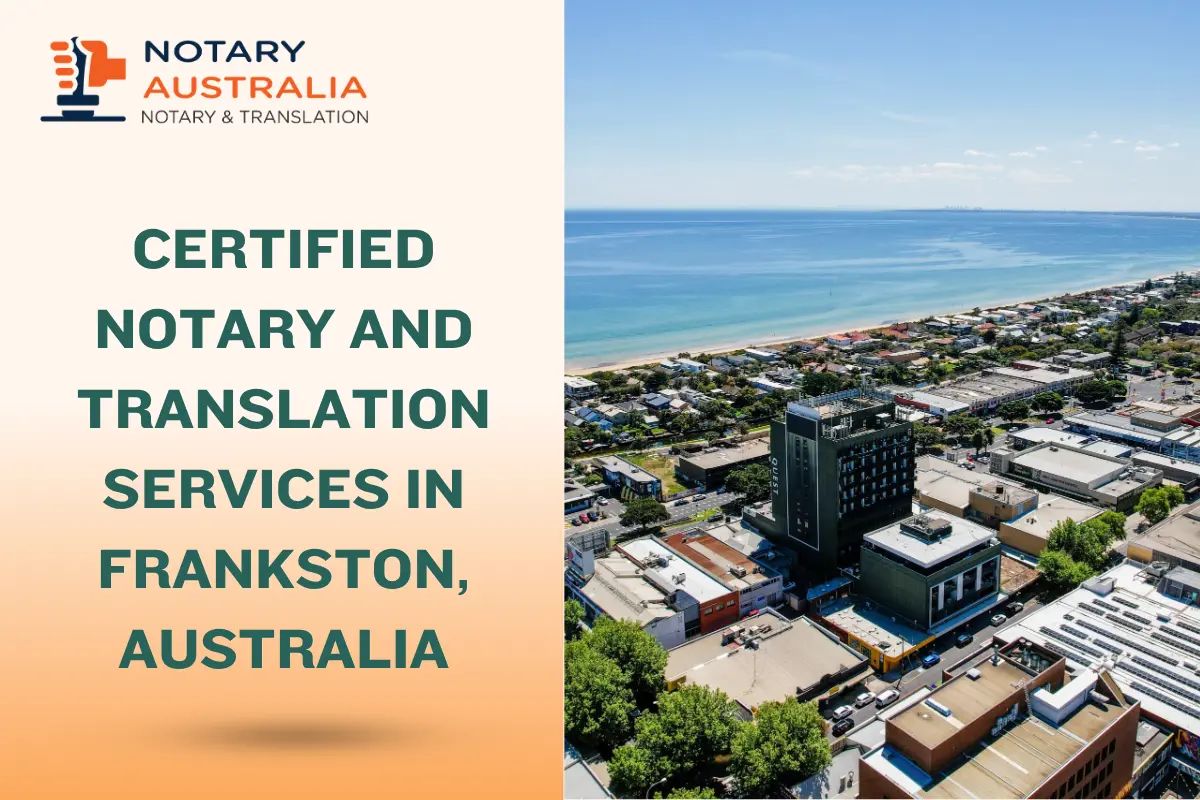
Table of contents
Frankston has a stronger British connection than most of Melbourne: England-born residents make up nearly twice the Victorian share. A lot of the notarial work people here need faces outward: a UK pension form, a document for family in Britain or New Zealand, a certificate for a job or course overseas. This guide explains which of those need a notary, which need only a free JP, and how to reach DFAT from the bayside.
Frankston and Frankston City Council
Frankston is governed by Frankston City Council. The council describes its area as about 131 km² on the eastern shore of Port Phillip Bay, running from Eel Race in the north to Olivers Hill in the south and inland to the Langwarrin and Skye hinterland. It puts the city about 40 km south of Melbourne, within the metropolitan area.
The 2021 Census counted 139,281 people in the city. 73.7% were born in Australia, against 65.0% across Victoria. England was the largest overseas birthplace (5.2%, against 2.7% statewide), followed by New Zealand, India, the Philippines and Scotland (0.9%, against 0.4%). The city is less linguistically diverse than Victoria as a whole: 83.6% of residents spoke only English at home, against 67.2% statewide. The most common other languages were Mandarin, Greek, Italian, Russian (0.5%, against 0.3%) and Spanish.
Popular places and things to do
- Frankston Pier and the waterfront. In August 2026 the council installed Flyway, a sculpture by the Taiwanese-Australian artist Yu-Fang Chi, along the pier. It is inspired by the migratory birds of the East Asian–Australasian Flyway.
- The Frankston Regional Arts Trail. When finished, the council says, this trail of about nine kilometres will link the foreshore with McClelland Sculpture Park and Gallery in Langwarrin through a series of public artworks and new shared paths.
- Bunarong Park, 9.3 hectares on sand dunes formed in the Ice Age. It has two walking circuits totalling two kilometres and a lookout over the bay.
- Olivers Hill lookout, at the southern end of the waterfront. The boardwalk from the pier leads towards it.
What Frankston residents typically need
- Overseas pension paperwork. Pension providers abroad sometimes ask for a life certificate or declaration signed before a particular kind of witness. Read the form. If it accepts a JP, you do not need a notary. If it asks for a notary, or is going to a country that requires an apostille, you do.
- Documents for the UK or New Zealand, such as powers of attorney, property papers and certified identity documents. The route depends on the receiving authority and the country's current Hague Apostille Convention status. Check the HCCH table on the day.
- Certificates for work or study abroad. A Victorian birth certificate, a national police check or a court document can often go straight to DFAT without a notary. Confirm with DFAT first. Australian university documents need verification by the university before DFAT will legalise them.
Who can translate documents?
For Australian agencies, use a NAATI-certified translator. You can search the NAATI Online Directory by language. Certification is national, so the translator does not need to be in Frankston, and Russian, Greek, Spanish and Mandarin are all widely covered. A notary does not translate. A notary can certify a copy of a translation, or witness a translator's declaration, if the receiving authority asks for that. For DFAT to legalise a translation, every page must carry the translator's name, signature, NAATI seal and practitioner ID, and the date.
Getting a document notarised and legalised
- Ask the receiving authority exactly what it wants. DFAT will not advise on this, and some authorities need nothing beyond a certified copy.
- Find a notary. In Victoria, public notaries are appointed by the Supreme Court of Victoria. The Society of Notaries of Victoria has a find-a-notary listing. Bring the original document and photo ID. A notary cannot work from a scan.
- Lodge with DFAT. The in-person option is the Australian Passport Office in Melbourne, by appointment, and someone can attend for you. Or send your documents by registered post to DFAT's Authentications Section at its Melbourne or Sydney GPO box (addresses on Smartraveller), with a self-addressed registered post envelope. DFAT does not publish a fixed processing time.
"Travelling notary"
Some notaries in Victoria will travel to a client, and some offer remote sessions. Whether a document notarised remotely is accepted is up to the authority that receives it, not Australian law, so check before you book. For a document that is not going overseas, a JP at a Document Signing Station is usually quicker and free.
When a JP is enough
Victorian JPs are volunteers and "cannot charge for their services". You can contact a local JP directly, or attend a Document Signing Station at a police station, library or council office during its rostered hours. Remote witnessing by a JP can be booked through the Royal Victorian Association of Honorary Justices. A JP can certify copies and witness statutory declarations and affidavits for Australian use. The Victorian Government notes that JPs are not notaries public, and a JP's certification cannot be apostilled.
Frequently asked questions
Is there a notary public in Frankston? We do not list individual notaries. Search the Society of Notaries of Victoria's listing by location.
My UK pension provider sent a form. Do I need a notary? Only if the form says so. Many forms list the witnesses they accept, and that list may include a JP.
Do I need a translator based in Frankston? No. Any NAATI-certified translator is acceptable to Australian agencies.
More for Victoria
JPs and bail justices are free witnesses for Victorian and Commonwealth documents; documents for overseas use need a notary.
- Witnessing Documents in Victoria: Authorised Witnesses
- Notary Public in Melbourne: How to Get Documents Notarised
- Notary and Translation Services in Victoria
- Bairnsdale
- Craigieburn
- St Albans
- Wangaratta
- Warrnambool