



Notary and Translation Services in Dubbo
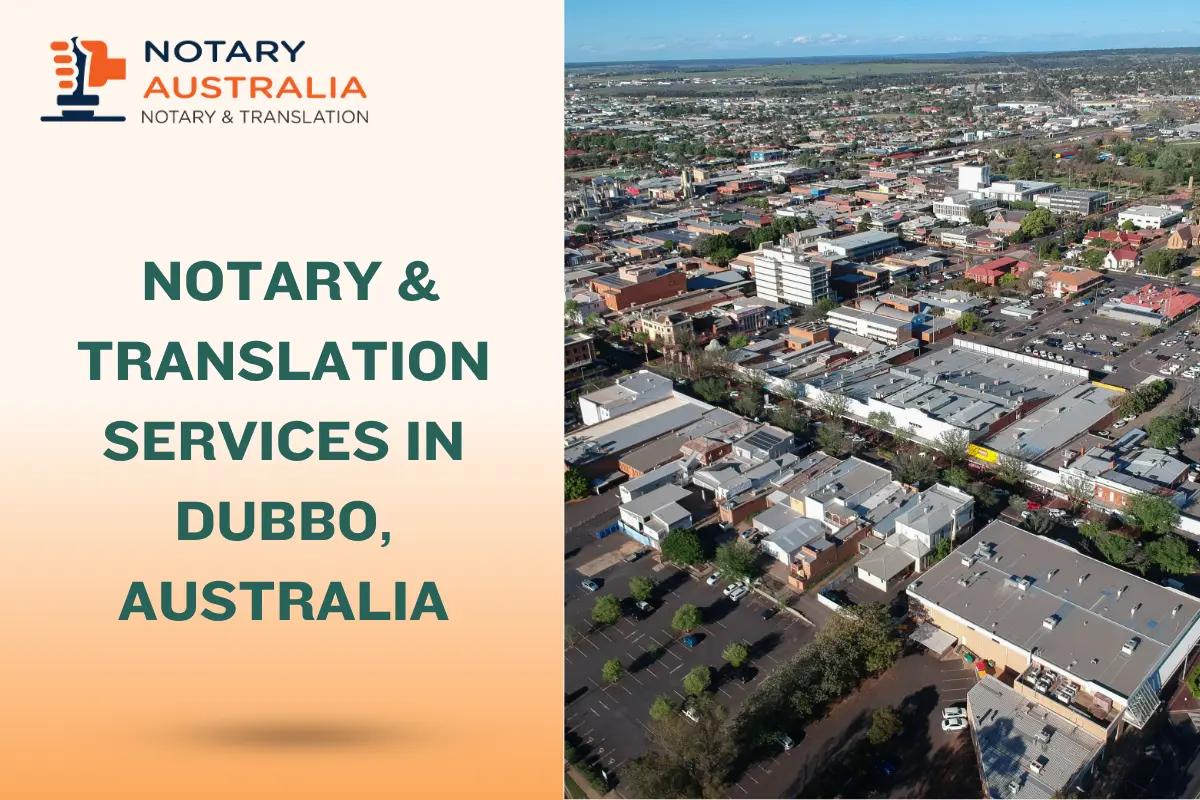
Table of contents
In the 2021 Census, the most common language other than English spoken at home in the Dubbo region was Nepali. That tells you a good deal about the documents that pass through a notary's hands here: police checks, degrees and family papers going to Nepal and India. The two countries treat Australian documents differently. This guide explains how, and covers notaries, JPs, DFAT and translations for people in Dubbo and Wellington.
Dubbo and Dubbo Regional Council
Dubbo sits on the Macquarie River, and the council's tourism site calls it a regional city in the heart of the Great Western Plains. Dubbo Regional Council was formed in May 2016 by merging the City of Dubbo and Wellington Council. Besides Dubbo, it covers Wellington and the surrounding villages.
At the 2021 Census the council area had 54,922 residents, with a median age of 36. One resident in six (16.6%) identified as Aboriginal and/or Torres Strait Islander. The largest overseas birthplaces were India (1.4%), Nepal (1.3%), England (1.0%), New Zealand and the Philippines. After English, the most common languages at home were Nepali (1.4%), Punjabi (0.7%), Malayalam (0.4%), Urdu (0.3%) and Mandarin (0.3%). Hospitals were the largest industry of employment, at 5.4% of working residents against 4.2% across NSW.
Popular places and things to do
- Taronga Western Plains Zoo, opened in 1977. It is an open-range zoo of more than 300 hectares, with over 5,000 animals from about 350 species. Visitors can drive, cycle or walk around it, and moats rather than walls separate them from the animals.
- Old Dubbo Gaol. It began as a courthouse lock-up in 1847, one of Dubbo's first government buildings, and operated until 1966. It is heritage-listed and in the council's care.
- Wellington Caves, also council-run, with the Cathedral and Gaden caves, marine fossils and megafauna remains.
- Terramungamine Reserve on the Macquarie River, where about 150 Aboriginal grinding grooves in the rock mark a meeting place of the Tubbagah people.
- The Royal Flying Doctor Service Visitor Experience.
Documents for Nepal and India
The first steps are the same whatever the destination. A private document, such as a power of attorney, an affidavit or a certified copy of your passport or degree, is signed or certified before an Australian notary. Some original public documents can go straight to DFAT with no notary. These include NSW birth and marriage certificates, national police checks and court documents, but confirm with DFAT first. The last step differs:
- Nepal. On the HCCH Apostille Convention status table as we read it on 24 September 2026, Nepal was not a party. A document for Nepal needs DFAT authentication, then legalisation at Nepal's embassy or consulate in Australia.
- India. Check India's current status on the HCCH table on the day you apply, then follow our India guide.
Australian degrees have a rule of their own. DFAT legalises a university degree or transcript, whether the original or a notarised copy, only after the university has verified the record. A notary's plain "true copy" certificate is not enough. DFAT will not legalise foreign education documents, even if they were notarised in Australia.
Documents issued in Nepal or India for use here are generally certified in the issuing country. An Australian notary cannot vouch for them.
Finding a notary, and when a JP will do
In NSW, public notaries are appointed by the Supreme Court. They are lawyers of at least five years' standing. The Society of Notaries of New South Wales has a Find a Notary search by name, postcode, region and foreign language. Its regions include Dubbo and Central West. Bring the original document and photo ID.
For documents used in Australia, a Justice of the Peace is free and usually enough. That includes statutory declarations and certified copies for a Department of Home Affairs visa application, which usually needs only an authorised person. The NSW JP Public Register can be searched by postcode and by language, including Nepali. A JP's certification is not accepted overseas and cannot be apostilled, so do not use one for anything going to Nepal or India.
Reaching DFAT from Dubbo
DFAT takes documents at any Australian Passport Office, by appointment only, and someone can attend on your behalf. From Dubbo, Sydney and Canberra are the realistic choices. Or post the documents by registered post to DFAT's Authentications Section at its Melbourne or Sydney GPO box (addresses on Smartraveller), with a self-addressed registered post envelope. DFAT does not publish a fixed turnaround.
Translations
For an Australian agency, a document in Nepali, Punjabi, Malayalam or Urdu should be translated by a NAATI-certified translator, searchable by language in the NAATI Online Directory. The translator does not need to be in Dubbo. DFAT legalises a translation only if every page shows the translator's name, signature, NAATI seal, practitioner ID and the date. For a document going to Nepal or India, ask the receiving authority whose translation it accepts.
Frequently asked questions
Is there a notary in Dubbo? We do not list individual notaries. The NSW Society's search has a Dubbo region; check it for current listings.
Can I get an apostille for Nepal? Not while Nepal is outside the Convention. You need DFAT authentication, then the Nepalese embassy or consulate.
Can a JP certify my police check for overseas? No. DFAT can legalise an original national police check directly, with no notary.
More for New South Wales
JPs witness statutory declarations and certify copies for use in Australia; NSW JPs are not authorised to witness documents for use overseas, which need a notary.
- JP or Notary in NSW: Choosing the Correct Witness
- Notary Public in Sydney: How to Get Documents Notarised
- Notary and Translation Services in New South Wales
- Notary Services in Sydney: Booking an Appointment
- Albury–Wodonga
- Ballina
- Batemans Bay
- Bega, NSW
- Bourke
- Broken Hill
- Byron Bay
- Campbelltown
- Coffs Harbour
- Coonabarabran
- Corowa
- Glen Innes
- Moree
- Port Macquarie
- Tamworth
- Tumut
- Wagga Wagga