



Notary and Translation Services in Tamworth
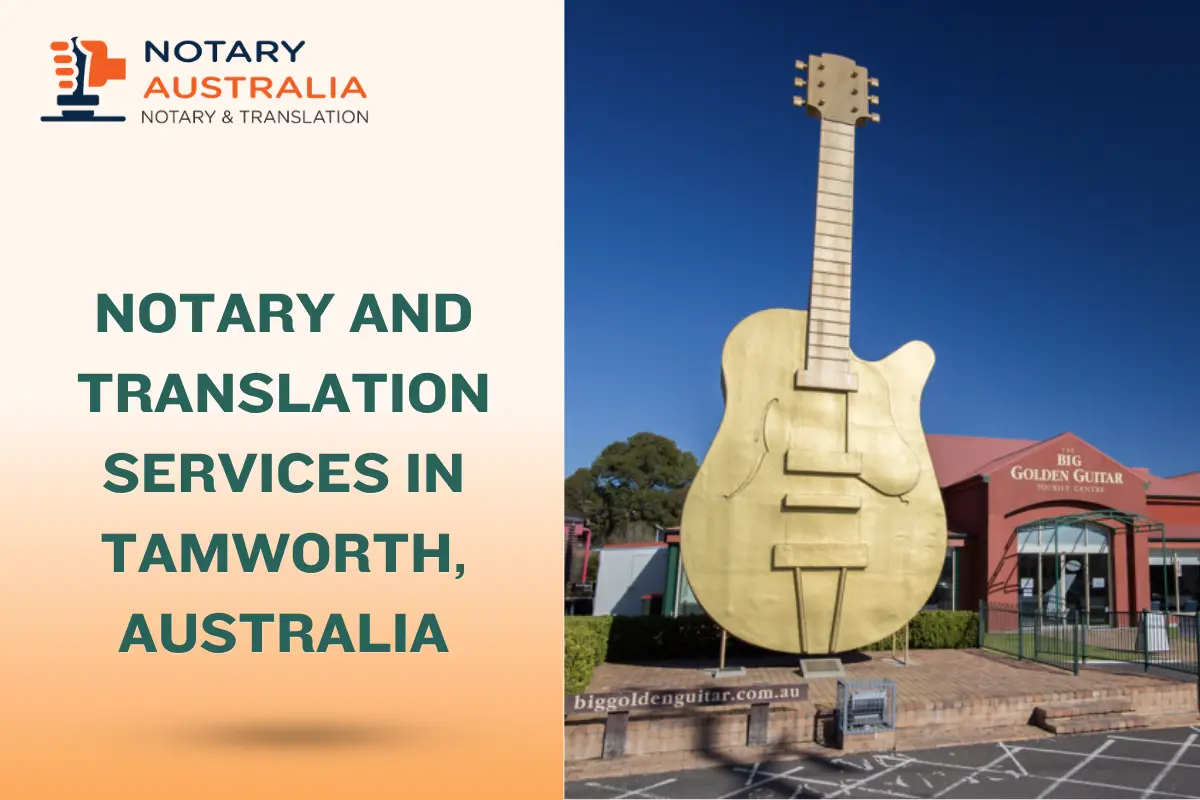
Table of contents
Searches for a notary in Tamworth often come paired with translation: "notarised translation", "certified translation and notary", "Home Office certified translation". Those are three different things, and the difference matters. Many people who ask for a notarised translation need only a certified one, which means one step and one fee fewer. This guide sorts them out, then covers finding a notary, using a JP, and reaching DFAT from the New England North West.
Tamworth and its region
Tamworth is the main city of Tamworth Regional Council, on the Peel River. The council's tourism site describes it as home to the Kamilaroi/Gamilaroi/Gomeroi people for thousands of years. At the 2021 Census the council area had 63,070 residents, with a median age of 39. One resident in eight (12.7%) identified as Aboriginal and/or Torres Strait Islander. The largest overseas birthplaces were England, the Philippines and India. The most common languages at home other than English were Mandarin, Vietnamese, Tagalog, Punjabi and Nepali, each under 1%. Meat processing employed 3.2% of working residents, against 0.2% across NSW.
Tamworth has two claims to fame. It calls itself the Country Music Capital. The Golden Guitar awards were first presented at Tamworth's Town Hall in 1973, and the Country Music Festival now fills ten days every January. And on 9 November 1888, Tamworth became the first place in Australia with municipal electric street lighting, which is why it is sometimes called the City of Light.
Popular places and things to do
- The Tamworth Country Music Festival in January, with the Golden Guitar Awards, which the council co-presents.
- The Big Golden Guitar, the city's best-known landmark.
- Tamworth Powerstation Museum, on the site where steam engines powered the 1888 street lights. It has two working steam engines and replica 1888 dynamos.
- The Peel River Valley lookouts, with views over the city.
Certified, notarised or "Home Office certified"?
A certified translation is done and signed by a qualified translator. For Australian agencies, including the Department of Home Affairs for visa applications, that means a NAATI-certified translator. You can search the NAATI Online Directory by language, and the translator does not need to be in Tamworth.
A notarised translation adds a notary. Usually the notary witnesses the translator's signature on a statement that the translation is accurate. Or the notary certifies a copy of the translation together with the original. The notary does not check the translation itself. Some foreign authorities ask for this. Many do not. DFAT can legalise a NAATI translation directly, provided every page shows the translator's name, signature, NAATI seal, practitioner ID and the date. So ask the receiving authority before paying for a notary as well.
"Home Office certified" refers to the UK Home Office. Its guidance is that a document not in English or Welsh must come with a full translation it can independently verify. The translator must confirm on the translation that it is a "true and accurate translation of the original document". The UK decides what it accepts, so check the current GOV.UK guidance for your visa type.
Finding a notary
In NSW, public notaries are appointed by the Supreme Court. They are lawyers of at least five years' standing. The Society of Notaries of New South Wales has a Find a Notary search by name, postcode, region and foreign language. Its regions include Tamworth and New England. Bring the original document and photo ID. A notary will not work from a scan or photocopy, and will check that you understand what you are signing.
When a JP is enough
For documents used in Australia, such as statutory declarations and certified copies for Home Affairs, a bank or a university, a Justice of the Peace is free and usually enough. The NSW JP Public Register can be searched by postcode, language and day of availability. A JP's certification is not accepted overseas, and it cannot be apostilled.
Reaching DFAT from Tamworth
Only DFAT issues apostilles and authentication certificates. It accepts documents at any Australian Passport Office, by appointment only, and someone can attend on your behalf. Sydney and Brisbane are the options within driving distance. Or send the documents by registered post to DFAT's Authentications Section at its Melbourne or Sydney GPO box (addresses on Smartraveller), with a self-addressed registered post envelope. Some originals need no notary at all. These include NSW birth and marriage certificates, national police checks and court documents, but confirm with DFAT first.
Whether you then need an apostille or embassy legalisation depends on whether the destination country is a party to the Hague Apostille Convention. Check the HCCH status table on the day you apply.
Frequently asked questions
Is there a notary public in Tamworth? We do not list individual notaries. The NSW Society's search has a Tamworth region; check it for current listings.
Do I need a notarised translation for my Australian visa? Usually not. Home Affairs generally expects a NAATI-certified translation, not a notarised one.
Can a JP certify a translation? A JP can certify a copy of a translation for Australian use. That says nothing about the translation's accuracy, and it will not be accepted overseas.
More for New South Wales
JPs witness statutory declarations and certify copies for use in Australia; NSW JPs are not authorised to witness documents for use overseas, which need a notary.
- JP or Notary in NSW: Choosing the Correct Witness
- Notary Public in Sydney: How to Get Documents Notarised
- Notary and Translation Services in New South Wales
- Notary Services in Sydney: Booking an Appointment
- Albury–Wodonga
- Ballina
- Batemans Bay
- Bega, NSW
- Bourke
- Broken Hill
- Byron Bay
- Campbelltown
- Coffs Harbour
- Coonabarabran
- Corowa
- Dubbo
- Glen Innes
- Moree
- Port Macquarie
- Tumut
- Wagga Wagga